



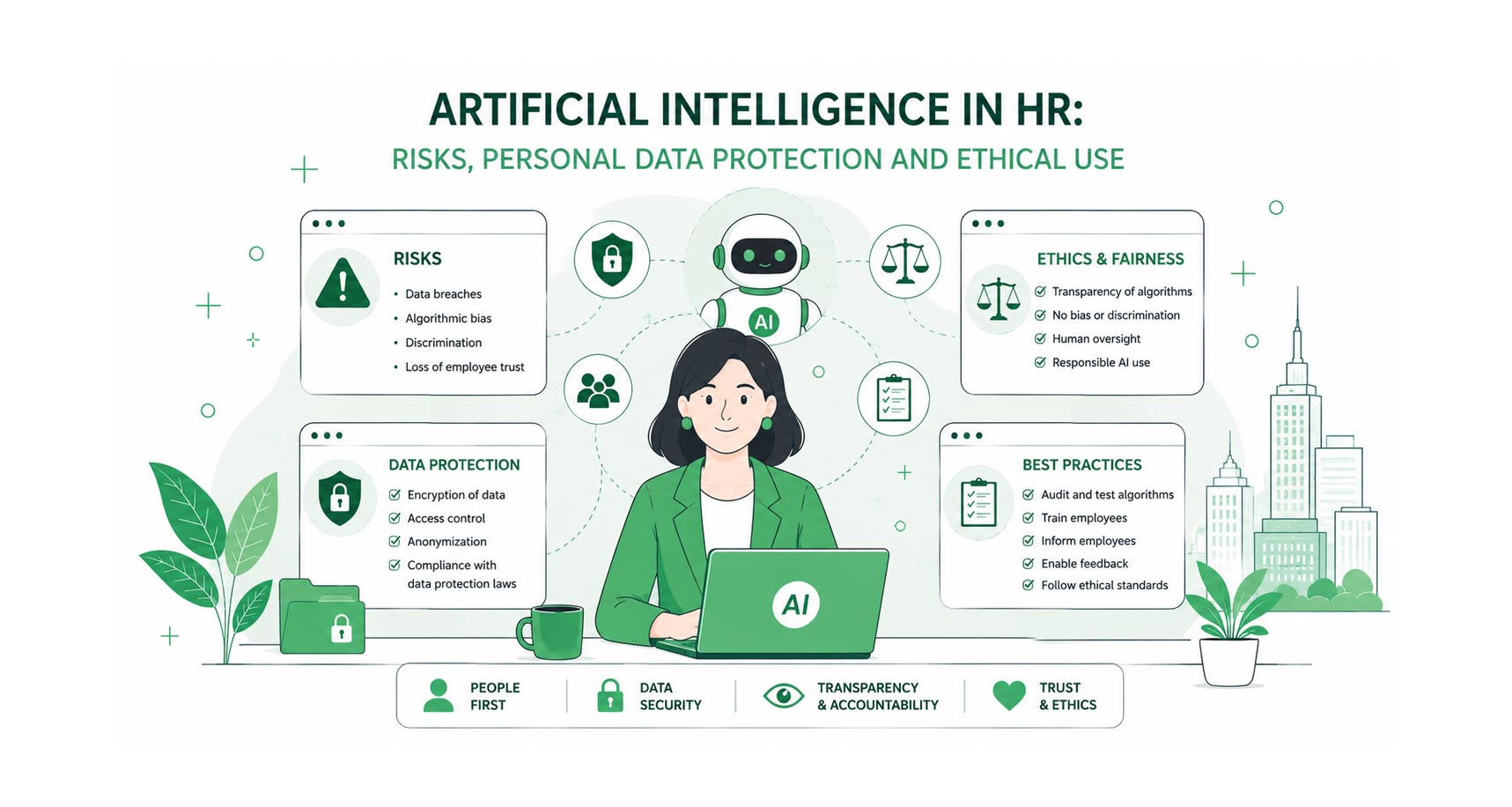
Artificial Intelligence in HR: Risks, Personal Data Protection, and Ethical Use
Artificial Intelligence in HR: Risks, Data Protection, and Ethical Use
Artificial intelligence systems are increasingly being integrated into human resource management processes. Today, companies use AI for candidate sourcing, automated resume screening, conducting online interviews, analyzing employee engagement, and creating personalized training programs.
Automation allows HR teams to save time and make faster decisions, but alongside its benefits, new challenges also arise. Since AI processes large volumes of personal information, issues of confidentiality, transparency, and fairness become especially important.
In many countries, regulators are paying increased attention to the use of algorithms in labor relations. Employers are increasingly required not only to ensure data security but also to be able to explain how automated systems influence HR decisions.
What employee data does artificial intelligence analyze
AI-based HR systems use various categories of information:
- Personal data: name, contact information, date of birth, citizenship, education, and professional experience.
- Work performance data: performance results, KPI achievement, project participation, and activity in internal company systems.
- Assessment data: results of tests, professional and personality evaluations, and skill development information.
- Multimedia materials: video interview recordings, voice messages, and transcripted interviews.
- Corporate platform data: information from CRM, LMS, task management systems, feedback tools, and internal communication channels.
Risks and how to minimize them
Risk of personal data leakage
One of the most serious risks remains unauthorized access to employee data. The risk increases when using third-party AI platforms, cloud services, or integrating multiple systems.
The consequences of such incidents may include financial penalties, legal claims, and loss of trust from employees and candidates.
How to reduce data leakage risk
- Assign specialists responsible for compliance with information security requirements.
- Regularly train staff on information security practices.
- Use modern data protection methods such as encryption, access control, and data anonymization.
- Verify how AI solution providers store and process user data.
Risk of algorithmic bias
AI models are trained on historical data. If biases existed in past hiring or promotion decisions, the algorithm may unintentionally reproduce them in the future.
For example, a system may lower the ranking of certain candidate groups due to patterns in the training dataset. Such situations not only create legal risks for employers but can also lead to the loss of strong candidates.
This is especially dangerous when recruiters only see a final candidate score without understanding the factors behind it.
How to prevent algorithmic discrimination
- Do not allow AI to make final hiring decisions without human involvement.
- Exclude sensitive attributes from datasets used for model training.
- Regularly audit algorithms for bias.
- Implement a Human-in-the-Loop approach, where key decisions are reviewed by experts.
Employee distrust of automated decisions
Even the most effective technologies may face resistance from employees. Many workers are cautious about algorithms influencing career development, performance evaluation, or promotion opportunities.
A lack of transparency can lead to lower engagement and negative attitudes toward digital initiatives within the company.
It is important to clearly inform employees and candidates about:
- what data is used for analysis;
- the role artificial intelligence plays in decision-making;
- how they can request explanations or appeal evaluation results.
Practical checklist for safe AI use in HR
For effective and responsible implementation of artificial intelligence, several core principles should be followed:
- Data access management. Define which information is confidential and establish rules for its use in AI systems.
- Vendor evaluation. Before integrating a service, review its privacy policy, data storage conditions, and compliance with legal requirements.
- AI output verification. Any recommendations, assessments, or analytical outputs generated by algorithms should be reviewed by specialists.
- Business risk assessment. Consider potential legal, technical, and reputational risks of using AI across different company departments.
- Improving digital literacy. Provide training on safe and responsible use of artificial intelligence and data handling.
AI as a tool for development, not a threat
Artificial intelligence can significantly enhance HR functions: speeding up recruitment, improving training processes, and supporting analysis of employee engagement and development.
However, the technology delivers maximum value only when used responsibly. Companies must focus on algorithm transparency, personal data protection, and fair treatment of all candidates and employees.
Organizations that implement AI openly and ethically gain not only technological advantages but also stronger trust from their teams and the labor market. In an increasingly digital world, this approach becomes a key factor in employer competitiveness.